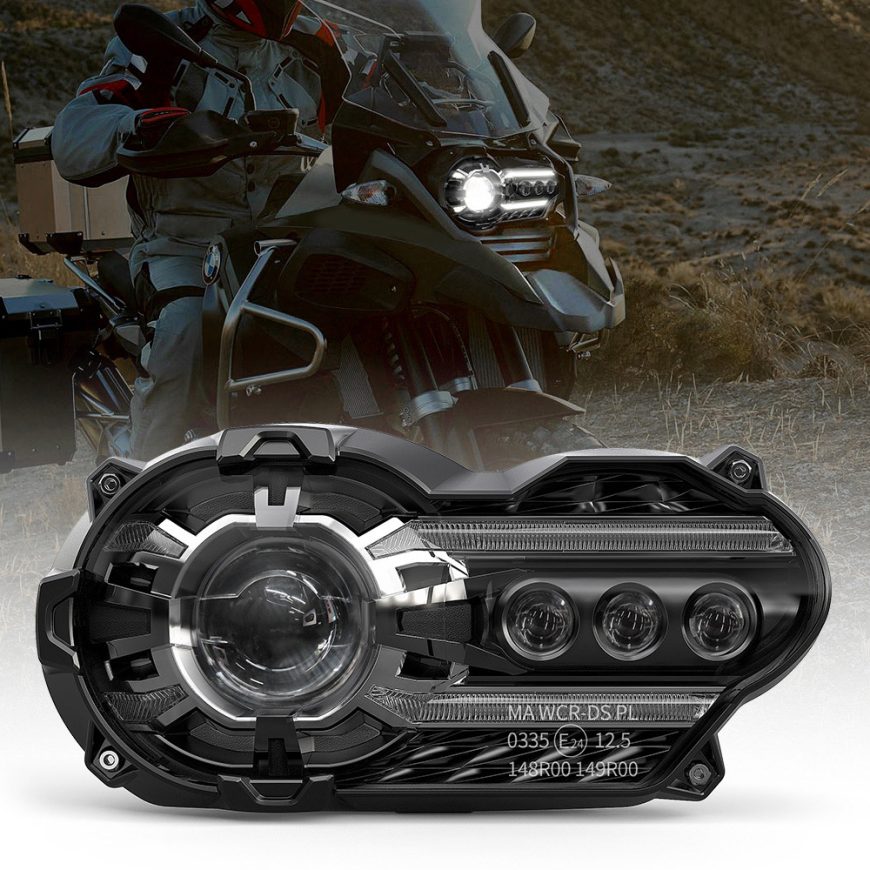
The BMW F800GS is a capable adventure motorcycle that thrives on long-distance touring and off-road exploration, but its factory halogen headlight has long been a point of criticism among owners. The stock H7 halogen bulb produces a warm, yellowish light that feels dim on unlit back roads, and its output fades noticeably with age. For riders who spend time on the road after dark, upgrading to LED lighting is one of the most impactful modifications available. There are several paths to consider, each with its own trade-offs in cost, complexity, and performance.
Drop-In LED Bulbs
The simplest and most affordable option is a drop-in LED bulb designed to replace the factory H7 halogen. These bulbs use an LED emitter mounted on a base that fits the stock socket, and many include a small cooling fan or braided heat sink to manage heat. The appeal is obvious: installation takes minutes, no wiring changes are needed, and the cost is modest. However, the F800GS headlight housing was designed around the light source of a halogen filament, which emits light from a small, roughly cylindrical point. An LED emitter is typically larger and positioned differently, so the reflector cannot focus the light as precisely. The result is often a brighter but less controlled beam, with more scatter and glare for oncoming traffic. Some premium drop-in LEDs are engineered to mimic the halogen filament position closely, and these perform noticeably better, but cheap generic bulbs frequently disappoint.
LED Projector Assemblies
For riders who want a proper beam pattern rather than a compromise, a complete LED projector assembly is the superior choice. These units replace the entire headlight housing with one designed from the ground up around an LED light source, using a projector lens to create a sharp cutoff and a focused, even beam. The improvement over the stock halogen is dramatic: whiter light, greater reach, and a clean cutoff that prevents blinding other drivers. The downsides are cost and complexity. A quality LED projector headlight for F800GS can cost several hundred dollars, and installation may require removing the front fairing and adapting the wiring. Some units also require a CANbus decoder or resistor to prevent error messages or flickering, since the bike’s electronics monitor bulb resistance.
Auxiliary LED Lighting
A third approach is to leave the stock headlight alone and add auxiliary LED lights instead. Many F800GS owners mount a pair of LED spot or flood pods on crash bars, engine guards, or dedicated brackets. This preserves the factory headlight’s legal compliance while adding significant light for off-road use. Auxiliary lights can be wired to a separate switch and are typically used only when no other traffic is present. The advantage is flexibility: you can choose the beam pattern and output that suits your riding, and the installation does not disturb the headlight assembly. The downside is that auxiliary lights do not fix a weak low beam, so if your goal is better everyday nighttime visibility, they are a supplement rather than a solution.
Legal and Practical Considerations
Before upgrading, check your local regulations. In many jurisdictions, LED bulbs installed in halogen reflector housings are technically not street legal because they do not meet the photometric requirements the housing was certified for. Complete LED projector assemblies that carry DOT or ECE approval are the safer choice for road use. Regardless of which option you choose, pay attention to heat management, beam alignment, and CANbus compatibility. A well-chosen LED upgrade transforms nighttime riding on the F800GS, but a poorly chosen one can create glare, reliability problems, and legal headaches.